

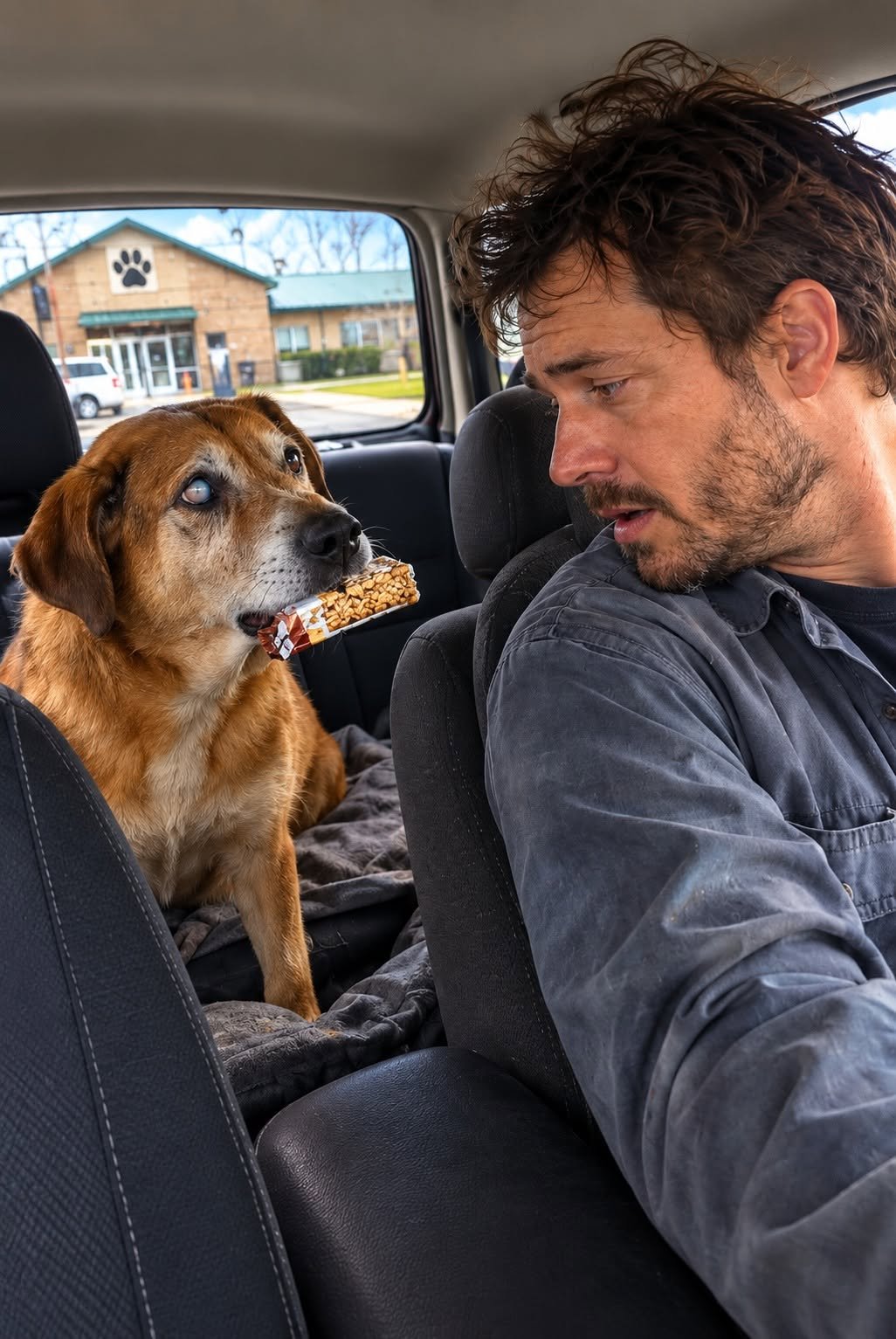
That dog had been testing me from the day I brought him home.
I had only gone to the shelter to look around. At least, that was what I told myself.
My apartment had become too quiet after my divorce. I worked long hours, came home late, heated up whatever was cheap, and watched television until I fell asleep on the couch.
Most of the dogs barked when I walked past their kennels.
Cooper didn’t.
He was a skinny brown mutt with gray around his muzzle and one cloudy eye. He sat in the back corner and watched me like he was trying to figure out whether I was safe.
Emma, the woman working there, told me he was about six years old.
“He’s sweet,” she said. “But he has some issues around food.”
I looked at his ribs and assumed she meant he ate too fast.
“I can handle that,” I said.
Emma gave me a long look.
“He was returned once already.”
That should have slowed me down.
It didn’t.
The first few days were almost perfect.
Cooper didn’t bark. He didn’t jump on the furniture. He followed me from room to room and slept beside the front door while I was at work.
For the first time in years, somebody seemed happy when I came home.
Then food started disappearing.
At first, it was half a loaf of bread.
I found it under the couch, still wrapped.
The next day, two granola bars vanished from the kitchen counter. One turned up behind the toilet. The other was tucked beneath my pillow.
Then I found dog food lined up beside the front door in a neat little pile.
Cooper wasn’t eating any of it.
He was hiding it.
I started putting everything in the cabinets.
He learned how to open them.
I moved the bread on top of the refrigerator.
He knocked over a chair trying to reach it.
One morning, I found a sleeve of crackers inside my work boot.
“Come on, man,” I said. “What are you doing?”
Cooper sat across the room with his head down.
I knew dogs sometimes stored food after going hungry. I tried to be patient.
But patience gets harder when everything else in your life starts falling apart.
My hours had been cut at the warehouse, so I picked up evening delivery shifts. My car needed repairs. My rent had gone up, and I was stretching every dollar until it nearly tore.
Some nights, dinner was coffee and a few fries left in a paper bag.
I never said any of that out loud.
Whenever Cooper stared at me, I smiled and said, “I’m fine.”
He always tilted his head when I said it.
Then the complaints started.
Cooper howled after I left for work.
The apartment manager gave me a warning. If it kept happening, Cooper would have to go.
I bought toys. I left the television on. I took him for longer walks before work.
Nothing helped.
One Thursday night, I came home exhausted and found the kitchen cabinet hanging open.
A plate lay broken on the floor.
It was an old blue plate that had belonged to my mother. I knew it was just a plate, but it was one of the few things I had left from her.
Cooper stood in the hallway with a wrapped sandwich in his mouth.
It was supposed to be my lunch for the next day.
Something inside me snapped.
I grabbed the sandwich and shouted, “I can’t keep doing this! I can barely take care of myself!”
Cooper flinched.
Then he slowly walked toward me and pushed the sandwich against my knee.
I didn’t understand.
I didn’t try to.
The next morning, I called Emma.
“I have to bring him back,” I said.
There was a pause.
“Are you sure?”
“No,” I said. “But I can’t lose my apartment.”
Cooper climbed into the back seat without a fight.
That made it worse.
He curled up by the door like he had done this before. Like he already knew that people changed their minds about him.
During the drive, I kept telling myself I was doing the responsible thing.
Cooper needed someone with more time.
Someone with more money.
Someone who didn’t get angry over broken plates.
When I pulled into the shelter parking lot, I turned around.
Cooper was holding a granola bar in his mouth.
It was the last one from the box in my kitchen.
“Seriously?” I whispered.
I reached back and took it from him.
He didn’t resist.
He placed his chin on the seat and looked away.
Then I remembered the old canvas bag under my bed.
Cooper had been dragging it around for days. I had thrown it into the trunk before we left because I assumed it contained more stolen food.
I got out and opened it.
Inside were three granola bars, a sleeve of crackers, two small bags of dog food, the wrapped sandwich, and an apple that had gone soft.
None of it had been eaten.
Then I noticed something.
Every item had come from near my work bag, my boots, or the front door.
Cooper had not been hiding food from me.
He had been placing it where I would find it before leaving for work.
I carried the bag inside and showed Emma.
She looked at Cooper through the glass doors, then closed her eyes.
“I should have explained better,” she said.
She told me Cooper’s previous owner had worked nights and often gone without meals. On the hardest days, that man fed Cooper but didn’t eat himself.
Cooper learned to collect unopened food and leave it beside the door.
“He panics when someone leaves the house hungry,” Emma said.
I stared at her.
“He wasn’t worried I would abandon him?”
