

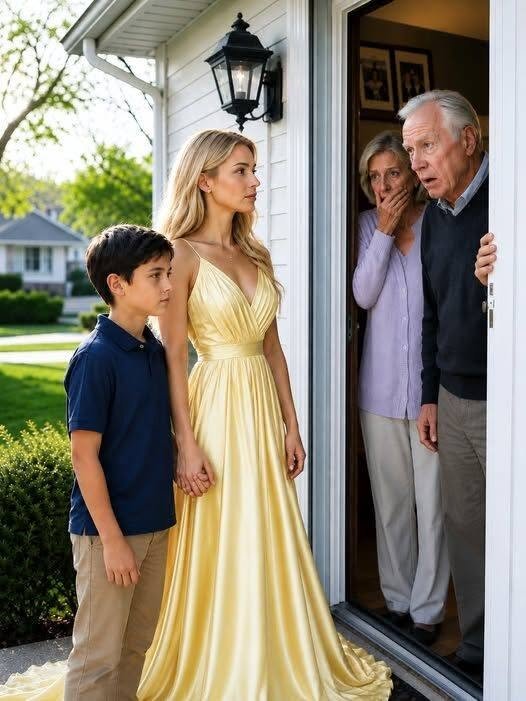
Vader stond langzaam op, zijn gezicht betrok. “Margaret…”
Moeder deed een stap achteruit. “Ik probeerde ons alleen maar in leven te houden.”
Ik kon de woorden er nauwelijks uit persen. “En je hebt je nooit afgevraagd waarom ze wilden dat je bij me uit de buurt bleef?”
Ze keek naar Leo.
Dat alleen al was het antwoord dat ik nodig had.
Ze wisten dat ik belangrijk was.
Ze wisten dat mijn kind ook belangrijk was.
Misschien begrepen ze de reden niet.
Maar ze wisten genoeg.
Vader hield de sleutel van de opslagruimte stevig vast.
‘Geen geheimen meer,’ zei hij.
Toen klonk er weer een ander geluid door de kamer.
Een autodeur die buiten dichtgaat.
We keken allemaal naar het raam.
Een zwarte sedan stond geparkeerd langs de stoeprand.
De motor bleef draaien.
En achter de getinte ramen zat iemand het huis in de gaten te houden.
DEEL 4 — De opslagruimte onder de storm
Tien lange seconden lang hield niemand zijn adem in.
De zwarte sedan stond stationair te draaien onder de straatlantaarn, als een roofdier dat op het juiste moment wachtte. Het was begonnen te regenen, dunne zilveren strepen dreven door het licht. De voorruit was te zwaar getint om naar binnen te kijken, maar ik voelde de aanwezigheid van wie daar ook wachtte.
Vader liep naar het raam.
Moeder greep hem bij zijn arm. “Robert, doe dat niet.”
Leo kwam dichterbij.
I wanted to stay strong for him, but my heart was pounding so v!olently I could feel it beating inside my throat.
“Do you know that car?” I asked.
Mom slowly shook her head. “No.”
Dad’s jaw hardened. “I do.”
All of us looked at him.
“I saw it two weeks ago,” he said. “Parked outside my doctor’s office.”
A chill spread through me. “Two weeks ago?”
He nodded slowly. “And again outside the pharmacy. I convinced myself I was imagining things.”
The sedan’s headlights blinked once.
Then it eased away from the curb and disappeared down the street.
Mom coll@psed onto the sofa. “They know you’re here.”
I tightened my grip on Leo’s shoulder.
For years I had imagined coming back to this house would only force me to face my parents. The anger. The apologies. The heartbreak. I had never imagined uncovering a secret buried so deeply that someone might still be protecting it ten years later.
Dad turned toward me. “We have to leave now.”
“You’re ill,” Mom said. “You can’t go running through the rain chasing shadows.”
“They aren’t shadows,” he snapped. “They’re why Ethan died.”
The word died made Leo flinch.
Dad noticed immediately and his expression softened. “I’m sorry.”
Leo swallowed hard. “It’s okay.”
But it wasn’t.
Nothing about this was okay.
Five minutes later, we climbed into Dad’s old pickup truck. Mom refused to stay behind, despite Dad telling her to remain home. She climbed into the back seat beside Leo and held an umbrella over both of them until the doors were closed.
I sat beside Dad in the passenger seat.
He drove.
The town looked unfamiliar through the rain-covered windshield. Streets I had known. Corners I remembered. The diner where I once studied after school. The church where Mom used to sing in the choir. The grocery store where Dad had bought strawberry cupcakes for my thirteenth birthday.
Now every memory seemed to hide another one beneath it.
A secret town beneath the town I thought I knew.
Eastridge Storage stood behind a closed hardware store near the edge of town. The office lights were off, but a keypad guarded the front gate. Dad stopped the truck beside it and frowned.
“I don’t know the code.”
Before anyone else spoke, Leo leaned forward from the back seat.
“Try Ethan’s birthday.”
I turned to look at him. “How do you know that?”
His face turned red. “You told me once. March 18.”
I had.
On one of those quiet evenings when grief made me reveal more than I meant to.
Dad typed in 0318.
The gate buzzed and slowly swung open.
No one said a word.
We drove between endless rows of storage units, the truck’s tires hissing across the rain-soaked pavement. The red tag attached to the key read C-17.
We found the unit near the rear of the property.
Dad shut off the engine.
Rain drummed loudly across the roof.
“Stay inside the truck,” I told Leo.
“No.”
“Leo—”
“This is about my dad too.”
His voice was quiet, yet unwavering.
Mom rested a hand on my arm. “Let him be with us.”
I hated it. I hated that my son had to carry any part of this burden. But I had spent ten years trying to shield him from the truth, and somehow the truth had still reached him.
Together, we stepped into the rain.
Unit C-17 was secured with an old padlock, rusty but still solid. Dad inserted the key.
It turned smoothly.
The metal door groaned as it rolled upward.
The smell reached us first.
Dust. Cardboard. Aging paper. Damp concrete.
Dad switched on a flashlight.
Inside stood three filing cabinets, two large plastic containers, and a wooden desk with a single drawer.
Resting on top of the desk was an envelope.
My name was written across the front.
EMMA.
My knees almost gave way.
With trembling hands, I picked it up.
The paper had grown yellow with age.
Inside was a letter.
Ethan’s handwriting.
Emma,
If you’re reading this, then I never made it home.
I’m sorry. I know those words are far too small for everything I’m leaving behind. There were things I couldn’t tell you because I feared that knowing them would place you in dan.ger. But there is one thing you must understand.
Your father is not my enemy.
He helped me.
At first, I didn’t trust him. I believed he was like the others—remaining silent because silence paid better than honesty. But Robert found me after one meeting and handed me copies of internal reports. He said, “There are kids drinking from that river. Someone has to stop this.”
He was frightened. But he helped anyway.
If he ever turns against you, something is wrong.
Trust the evidence.
Trust the boy.
And trust the sentence I taught you.
My breathing stopped.
The sentence.
I read those words again.
Trust the boy.
Leo looked up at me. “What sentence?”
I couldn’t answer.
Because all at once, I remembered.
Ethan had once laughed and said that if we ever had a child, the very first sentence he would teach him would be, “The river remembers what people bury.”
I laughed too. It sounded beautiful and oddly mysterious.
